Is My Dog Overweight? 7 Signs to Look For
Key Takeaways
- There's no single healthy weight for every dog — body condition, breed, age and frame all matter.
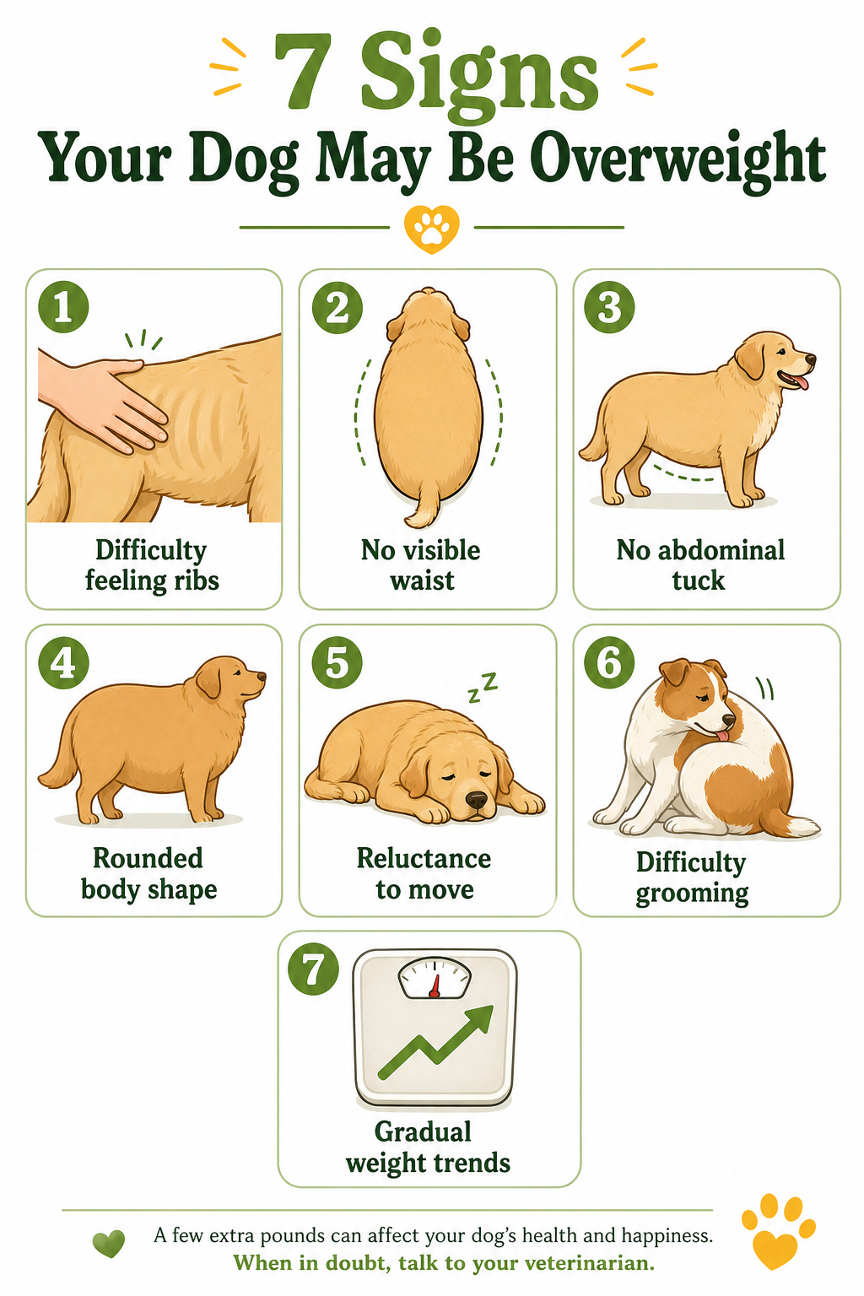
- You can check your dog's weight at home with a simple rib, waist and side-profile check.
- Weight gain usually happens when energy in exceeds energy out, but treats, age and activity play a part.
- A vet-supported plan with the right food, measured portions and daily activity is the kindest path to a healthy weight.
Wondering, "is my dog overweight?" You're not alone — it's one of the most common questions caring dog parents ask. The good news is you can assess far more than the number on the scales. Body shape, rib coverage, waist definition and everyday movement all offer helpful clues, and your vet can give your dog an individual assessment of healthy dog weight. Here's how to tell — and what to do about it.
What Is a Healthy Weight for a Dog?
There's no single healthy weight for all dogs. Appropriate weight depends on breed, frame, age and individual body composition, which is why body condition is an important complement to weighing. So if you're still asking is my dog overweight, the answer sits more in shape and feel than in a single number. Vets often use a 1–9 scale (such as the WSAVA body condition score), where a score around 4–5 reflects an ideal weight — ribs felt easily, a visible waist and a tucked abdomen. Kilograms alone can't tell you whether every individual dog is at an appropriate weight, and a dog weight chart gives breed context but has limits for assessing one individual.
7 Signs Your Dog May Be Overweight
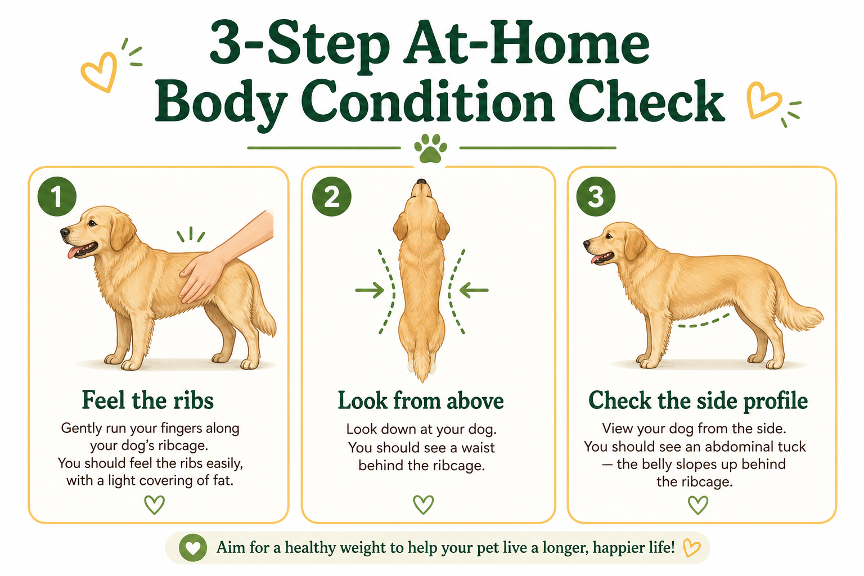
If you're asking "is my dog overweight?", these seven practical indicators can help. Every dog should be assessed in context:
- Difficulty feeling your dog's ribs — ribs hard to feel beneath a layer of tissue can suggest increased body condition.
- No visible waist — from above, a healthy dog shows an obvious waist behind the ribcage; its absence may indicate extra weight.
- No abdominal tuck from the side — a side profile should show a tucked-up abdomen; a sagging belly can be a clue.
- A rounded, broadened body shape — rather than a defined silhouette, the outline may look rounded.
- Reluctance to move or tiring quickly — an overweight dog may slow down on walks or rest more often.
- Difficulty grooming — struggling to reach certain areas can signal extra weight.
- Gradual weight trends — even small, steady increases over time can mean your dog is overweight.
When several signs appear together, it's worth a conversation with your vet.
Why Do Dogs Become Overweight?
Weight gain happens when energy intake consistently exceeds energy expenditure. But feeding habits, treats, activity, life stage and certain health factors all influence your dog's weight. Portions that exceed individual energy needs add up gradually, treats and table scraps add more to daily energy intake than many owners realise, and reduced activity or age-related changes shift how much energy your dog needs.
How Much Should You Feed a Dog by Weight?
Body weight is one factor in estimating feeding amounts, but the correct portion also depends on the food's energy density, life stage, activity level, body condition and your dog's individual needs. Asking is my dog overweight is only the start — matching food to those needs matters. For guidance on how much to feed a dog by weight (kg), our how much food should you be feeding your dog article is a good start.
How to Help Your Dog Lose Weight Safely
Safe dog weight loss focuses on a calorie-controlled feeding plan, accurate portions, sensible treat management and suitable activity — ideally with veterinary guidance. Speak to your vet to establish your dog's current condition and a safe target before big dietary changes, choose an appropriate weight management dog food to support calorie control while still providing complete nutrition, measure every meal so portions stay consistent, account for treats within the overall plan, and support gentle, regular daily activity.
What Is Weight Management Dog Food?
Weight management dog food is formulated to support calorie control while still delivering complete and balanced nutrition. Reducing excess weight differs from maintaining an appropriate weight once achieved, so your food choice may change as your dog's needs do. Look for complete and balanced nutrition, appropriate energy intake, life-stage suitability and evidence-based formulation — portion control still matters even with a specialist food.
How to Help Your Dog Maintain a Healthy Weight
Maintaining an appropriate weight is an ongoing process involving consistent portions, appropriate nutrition, regular activity and monitoring for gradual changes. Keep portions consistent to prevent gradual overfeeding, review feeding as your dog's needs change, and make healthy weight part of routine vet care.
Every dog deserves to feel their best, and a healthy weight is one of the kindest gifts you can give them. If you think your dog might be carrying a little extra, start with a simple body condition check at home, then chat with your vet about a plan for your one-of-a-kind companion. For everyday nutrition that supports a healthy, happy dog, explore our range of PEDIGREE® adult dog food and dog care articles. Feed the good.™
FAQs
1. How can I tell if my dog is overweight?
Look for signs like difficulty feeling the ribs, no visible waist from above, a sagging abdomen and reluctance to exercise. A simple at-home body condition check — feel the ribs, look from above, check the side profile — is a great starting point, with your vet's assessment to confirm.
2. What is a healthy weight for my dog?
There's no single number. A healthy weight depends on breed, frame, age and body composition. Vets often use a body condition score (such as the WSAVA 1–9 scale) rather than kilograms alone, with a score around 4–5 usually reflecting an ideal weight.
3. Should I be able to feel my dog's ribs?
Yes — in a dog at an ideal weight, you should be able to feel the ribs easily without pressing hard, with a light layer of tissue over them. If the ribs are difficult to find, it may be a sign your dog is carrying extra weight.
4. How quickly should an overweight dog lose weight?
Weight loss should be gradual and steady — safe dog weight loss is typically around 1–2% of body weight per week, but your vet is the best person to set a safe target and timeline for your individual dog.
5. When should I speak to my vet about my dog's weight?
If you notice several signs of excess weight, if your dog has gained weight quickly, or before making significant changes to their diet or activity. Your vet can assess body condition, rule out underlying health factors and help build a safe, personalised plan.
YOUR DOG MAY ALSO LIKE...
Why your older dog needs protein
As part of your dog's natural metabolic processes, they'll lose a certain amount of protein every day through loss and turnover of hair, skin, nails and bodily secretions. Historically there's been a belief that reducing protein intake in older dogs will relieve ‘stress’ on their kidneys and may help to prevent or slow progression of kidney disease. More recent research has shown that this theory cannot be supported. Whereas older dogs have a higher incidence of kidney disease than younger dogs, not all older pets will develop kidney failure. The routine use of protein restricted diets in all senior dogs is therefore not necessary unless kidney function is impaired. Very low protein diets may actually be associated with a risk of protein malnutrition and poor palatability. In general, healthy older dogs should have diets based on their individual needs, which will be related to bodyweight, health status, condition and physical activity. There are really two main reasons why your dog requires protein. First to provide the essential amino acids that their own body can't make. Secondly, to provide nitrogen for making non-essential amino acids and other nitrogen-containing compounds. As part of your dog's regular metabolic processes, they'll lose a certain amount of protein every day through loss and turnover of hair, skin, nails and bodily secretions. What's more, about 1% of body protein is broken down and re-synthesised every day. However, if the body isn't taking in enough protein, this process can break down and result in a protein deficiency. Some signs of protein deficiency include:Loss of appetite and weight lossDull coatFluid retentionDistended abdomenSwelling of the legsLethargySo how much protein does your senior dog require? To a certain extent it depends on their breed, environmental factors, and variations in the dietary source of protein. If your senior dog has special needs, consult with your veterinarian.
READ NOW
10 great reasons to adopt an older dog
Includes some little-known benefitsSadly, our nation's shelters and rescue organisations always house needy older dogs, and usually these animals wait far longer to find their 'forever' home than younger dogs. Ironically, older dogs can often be a better choice for adoption because of their maturity and life experiences. Here are just ten of many great reasons you may want to consider adopting on older dog.1. The first and probably most important reason to consider bringing an older dog into your life? You'll be providing a home for a deserving dog, ready to give love by the bucket-full and to be your instant companion for years to come.2. Older dogs are almost always housebroken and don't require the commitment of time and dedication needed to teach a puppy the rules of bathroom etiquette - not to mention time spent cleaning up little 'surprises'!3. Older dogs are fully-grown and mature; so you know exactly what type of dog you're getting in terms of size and temperament, rather than guessing with a puppy.4. Older really IS wiser, in many cases! Older obedient dogs are generally more patient, less rambunctious and more disciplined than puppies.5. Since the majority of older dogs are housetrained, obedience trained and probably knows several tricks; demands on your time are significantly less than puppies or younger dogs; which leaves more time for yourself.6. Older dogs are used to normal everyday schedules - increasing your chances of getting a good night's sleep, because they sleep when you do. Bathroom breaks, feedings and playtime are reserved for daytime.7. No gnaws, nips or bites! Older dogs have already gone through the teething phase, sparing your dining room furniture, best pair of shoes and favourite underwear from chew marks.8. Older dogs can sometimes be trusted for longer periods alone than younger dogs (of course, you should never leave him alone for longer than entirely necessary).9. A trained older dog will know many more commands, and have a greater attention span, than a bouncy pup.10. Older dogs may have lived through the death of a previous owner, or abandonment by a less caring household than yours; this often makes for a very loyal, grateful companion!
READ NOW
Adopting a second dog
Is it a good idea to adopt a new dog when you have a senior dog at home?THINGS TO CONSIDER.Are you thinking about adopting a second dog? If you have a senior dog in your home, there are a few important things to consider before you take action. After all, your dog has an important place in your family, and his feelings are important. Your senior dog has set routines and a well-established relationship with the members of your family, all of which could become upset with the introduction of a new dog. Proper introductions when bringing a new dog into a family with a senior dog, it's important to make sure that the two dogs get along harmoniously. Getting them both off on the right paw is vital to their future relationship, so make sure you introduce the dogs prior to "moving in" day. It's a good idea to do this in a pleasant environment on neutral ground, not in what will be their shared home. Both dogs should be kept leashed during the meeting, with a caregiver for each dog. This ensures that it will be easy to separate them if they start to show signs of aggression. If there is growling, or other signs of aggression, separate the dogs, distract them each with play, and then try again.Don't scold; it’s important that you do everything possible to make the experience pleasant, as this is what they will remember about the other dog. The transition will be easier if they associate each other with treats and a fun day at the park, rather than being reminded of a scolding when they see the other dog. Of course, part of ensuring that the experience is pleasant is to be sure that the dogs are up-to-date on their vaccinations.A senior dog and a puppy. If you have an older dog, and are bringing a puppy into your home, the older dog may feel that his turf is being invaded. As a result, he may be wary of the puppy. To help the senior canine feel more comfortable, it's a good idea to wait until the puppy is asleep before you introduce the dogs. While keeping a firm grip on the older dog's collar, let him sniff around the puppy. Also, make sure the older dog gets some quiet time alone with you during the first few weeks of him sharing his home with the puppy. These "Introduction Tips" will go a long way to creating a pleasant atmosphere and harmonious relationship between your old and new canine companions.
READ NOW
Adopting the right adult dog for you
Choosing the right dog, preparing your home and establishing ground rules.Advantages are that most adult dogs are already house-trained, know basic commands, and they tend to be calmer than puppies. There is usually a variety of adult dogs available for adoption through rescue organisations, breeders and private individuals. A senior dog makes a great companion for an older adult, because these dogs tend to be less active, and require less exercise than a younger dog.Adult dogs will bond with you and your family, just as easily as puppies. How do you choose the right dog for you?First, take your time. Adult dogs are available for adoption in many sizes, breeds and temperaments, and not every breed is right for every lifestyle. Think about your lifestyle, family size, the size and location of your home, and the time you are willing to spend with the dog. We recommend asking friends or visiting a local vet, breeder or rescue group to find out about different breeds, and which would best match your lifestyle. It's easy to fall in love at first sight, but you should spend time with a dog before adopting him.Look for a dog that is calm and has basic obedience training, and avoid aggressive dogs. Find out everything you can about the dog including:Why is he available for adoption? What is his temperament? Does he have any behaviour problems? How is he with children, cats, and other dogs? Is he neutered? Are his vaccinations up-to-date? Does he have, or has he had, any illnesses? Preparation, once you have made the decision to adopt an adult dog, the key to successfully welcoming him into your home, is preparation. Before bringing him home, select a veterinarian, buy all the toys and equipment you will need (such as collar and leash, bowls, brush and comb) and choose a nutritionally complete adult dog food. Dog proof your home and upon bringing your new dog home immediately get him a licence and identification tag. It's also a good idea to take a photo of him. The photo may come in handy in case you need to make a "dog missing" poster - and this can happen to even the most diligent owners.House rulesMake sure everyone in the household, knows what the house rules will be, now that you've brought your dog home. For example, decide whether he will be allowed on the couch and stick to your rules at all times. Your new adult dog will be happy for the chance to become part of your household, and giving him clear behaviour guidelines will help him understand, what is expected of him, so he can settle more easily into your home. Most dogs take about a month or so to feel comfortable in a new home, establishing and following a routine are the best ways to make this happen.Enjoy! Welcoming an adult dog into your home may take a little time and patience, but it's well worth it. If you are careful about choosing your dog, and follow these basic guidelines, he will make a great addition to your family for many years to come.
READ NOW